
Ten most common septic tank problems
The ten faults we see most often in septic tanks, what causes them, and what each one means for your system.
Key takeaways
- The ten most common septic tank problems are tree roots, ground movement, vehicles, collapsed baffles, damaged dip pipes, hydrostatic pressure, age, poor maintenance, bad installation and changing ground.
- Tree roots, ground movement and vehicles driving overhead can crack the tank, the soakaway or the pipes to them.
- A collapsed baffle or a knocked-off dip pipe lets solid waste into the soakaway and blocks it for good.
- High groundwater pressure can push a tank out of the ground and detach it from the pipe from the house.
- Old tanks work less efficiently, and soakaways do not last forever.
- A soakaway installed without a percolation test, or in ground that later becomes waterlogged, may stop working.
- Have your tank emptied regularly, typically every year, and use an experienced professional for any installation.
Nasty stuff bubbling up in your garden? Toilets not flushing properly? Noticing some unpleasant whiffs in your garden? Here’s our guide to the ten most common septic tank problems.
With your septic tank tucked neatly away underground, you’ll be hoping that it’s ticking along nicely. The last thing you want to be contemplating is paying out your hard earned money to fix any problems that might crop up. Or thinking about what any work needed might mean for your garden and the flowerbeds you’ve lovingly tended over the years.
Forewarned is forearmed as they say. If you know what to look out for, you can try to nip any problems in the bud. So don’t bury your head in the sand, check out our list below of the ten most common septic tank problems below:
Tree root damage
Did you know that roots from trees and shrubs can actually grow through the walls of a septic tank, soakaway, or the pipes leading from the house to the tank?
Tree roots can cause problems because water from the ground can get in to the tank, as well as the nasty stuff from inside the tank leaking out. All of this can stop the system from working properly, and will often create a horrible mess in the area where the system is.
Ground movement
The ground around your septic tank can shift slightly, often without you even noticing above ground. This puts a huge amount of pressure on the tank which can cause fractures or cracks to appear in the walls.
This can create two problems: firstly, you may find your septic tank backing up and needing to be emptied a lot more. Secondly, if ground water is able to get in to the tank through the cracks, it stops the tank being able to separate the waste that goes into it.
Vehicle damage
As most properties with septic tanks and soakaways are in the countryside, they are sometimes located within neighbouring farmland. Farm vehicles such as tractors can drive over the top of the septic tank or soakaway, putting enough pressure on them to cause real damage. In the case below, a cement mixer drove over the top of a septic tank, which then collapsed under its weight!
Collapsed baffle
You may be baffled about what a baffle is, but when we’re talking about septic tanks it is a barrier within the tank which stops any of the lumpy stuff from escaping into the soakaway system. Below is a picture of what a collapsed baffle looks like, although if you are not used to peering into septic tanks, it may not be obvious what it is you are looking at!
You see, soakaway systems are only meant to deal with liquid waste, and they can’t handle anything lumpier (I’m trying to be subtle here, and avoid the use of the word poo).
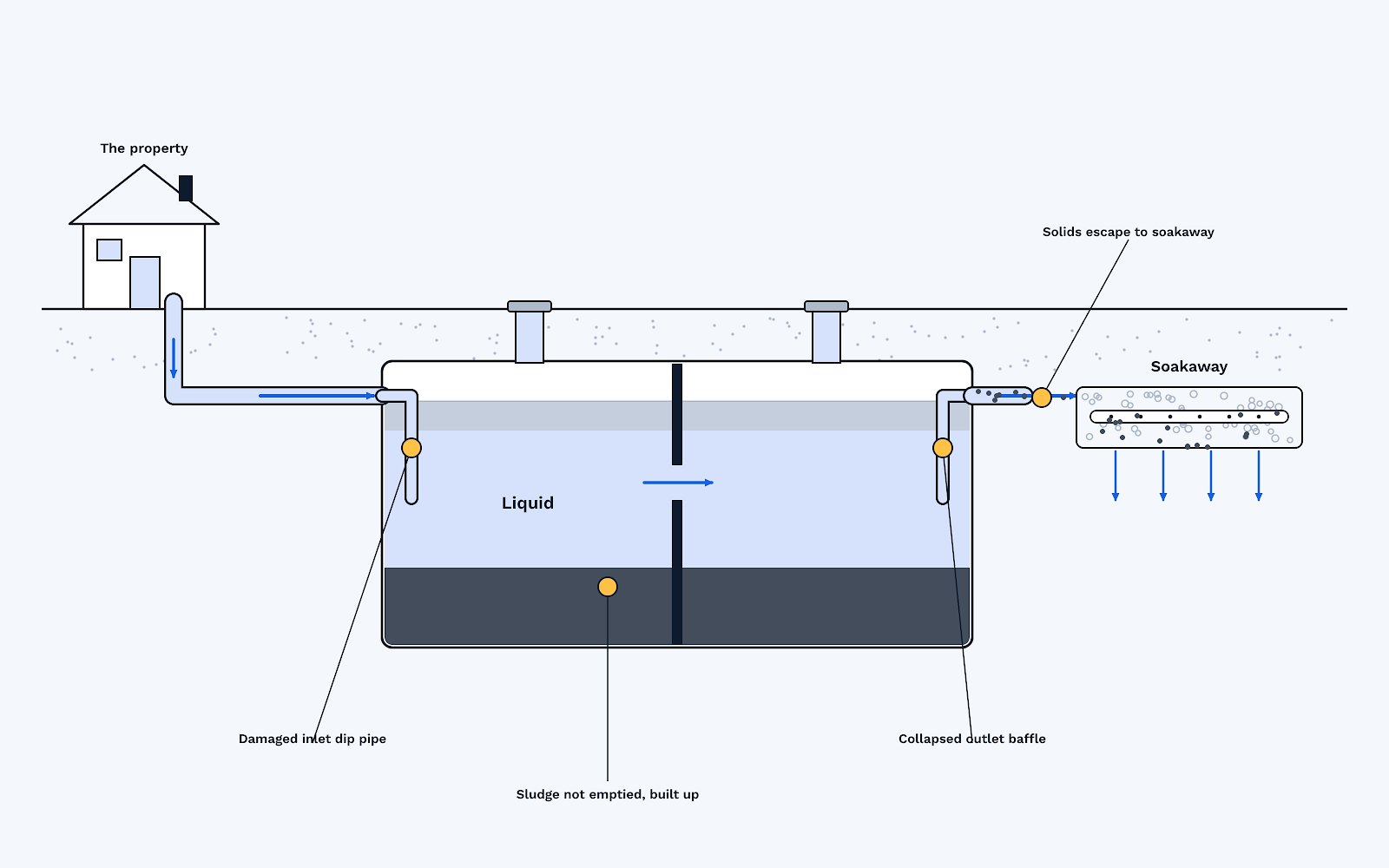
When what you flush down your loo goes into the tank, it separates into three layers: here’s how your septic tank works. The solid stuff (ok, the poo) falls to the bottom of the tank, and any fats/oils (sometimes from what’s flushed down your sink) float to the top.
The liquid stuff is left in the middle. It is only this dirty water that is meant to pass into the soakaway system or outlet pipe. If the baffle is damaged, there is no longer a barrier stopping the nasties from getting into the soakaway system.
In case you’re wondering, the idea of a soakaway system is to allow the dirty water that has left the septic tank to `percolate’ through the soil around it. The soakaway pipework is usually perforated or slotted to help this happen.
The process of the dirty water percolating through the soil provides a form of treatment of the waste, and it is then safely dispersed into the surrounding sub soils without causing any pollutions or nasty niffs.
When the lumpy stuff (yes, I do mean poo) enters the soakaway system, it fills the tiny voids in the soil and the treatment stops happening. Once this has happened, it cannot be undone, and no further treatment of the waste will be able to take place.
The soakaway system then gets blocked up with the waste from the septic tank. It can back up through the system and into your house, or it works its way up to ground level and starts to pool on the surface.
Not quite the water feature most people would choose for their garden!
Damage to dip pipes
Adip pipe (which can also be known as a T-pipe) exists to ensure that only the correct type of waste from the septic tank exits into the soakaway system or outlet pipe. It performs a similar function to the baffle I talked about before, and the type of septic tank you have will dictate whether it has dip pipes, a baffle or both.
Often, when we undertake a septic tank inspection, we find the outlet dip pipe resting at the base of the tank (see below).
Sometimes, this is because the dip pipe has been knocked off during a routine emptying. The missing dip pipe means that the wrong stuff escapes into the soakaway system, and causes the same problems as with a collapsed baffle.
Please watch our video below which explains how a septic tank soakaway is affected when a dip pipe is damaged.
Most faults start at a few points: a damaged dip pipe at the inlet, a collapsed baffle at the outlet, and sludge left to build up until solids carry through. Each one sends the wrong material into the soakaway, where it causes a blockage.
Septic tank dip pipe damage
There are many ways in which septic tanks can become damaged. In this video, we will look at what happens to a typical septic tank soakaway system when the `dip pipe’ is damaged or has been knocked off.
Hydrostatic pressure
It is hard to believe that the volume of water underneath the ground can be so high that it can put huge pressure on to a septic tank.
In extreme cases, this pressure from the water (the technical term for this being `hydrostatic pressure’ can cause the tank to literally `pop’ out of the ground.
This can cause serious problems for the property owner, as the pipe leading to the tank will become detached from the tank itself, resulting immediately in the drainage system backing up, often into the property itself.
This problem needs to be resolved urgently, for advice please call our team today on 0800 028 9903.
Age of the septic tank
Some septic tanks can be over 100 years old, and will look very different to a modern day equivalent. For example, they would not have had dip pipes and would often have been a single instead of double chamber structure.
It is possible that a tank of this age could still be working well enough, but it certainly won’t be doing so as efficiently as a modern day tank, and this may show up some septic tank issues for the property owner. There is also no set lifespan for soakaway systems, but they certainly don’t last forever, and in time they may start to cause problems.
Lack of maintenance
It’s really important that a septic tank is emptied regularly, typically every year. You should get a local tanker company to come and do this for you, they should hopefully then remind you when it’s time for it to be emptied again.
Incorrect installation or faulty workmanship
Correctly installing a septic tank or soakaway is a complex project to manage, it’s crucial that you get any installations done by an experienced professional.
There are a lot of problems that can arise if it’s not done properly. The soakaway system installed could be too small for the property, which could cause a lot of problems. But even worse than that, if a system that’s been put in doesn’t comply with all the legislation that relates to septic tanks and other drainage systems, the owner of the property can be prosecuted. It might make for an interesting story down the pub, but no-one wants to go to prison for a dodgy septic tank!So bear in mind these two key rules:
- A percolation test should be undertaken to ensure that the ground conditions are suitable for a soakaway, and also to determine the correct size and depth of the soakaway. Modern soakaway systems are often referred to as drainage fields.
- Any installation must comply with any applicable British Standards or Environment Agency legislation
A change in ground conditions
As I mentioned above, when a drainage system is installed, a percolation test must be carried out to make sure that it’s appropriate for the ground conditions at the property. If the ground is too wet, for example, a soakaway system won’t work properly.
However, over a number of years, ground conditions can change from the point in time when a drainage system was installed. In time, the ground may become more saturated with ground water. This means that a soakaway that had been put in the ground when the conditions were suitable may no longer be able to work properly.
If your property has a septic tank, I can imagine that this list might make for quite daunting reading. If you show your drainage system some TLC (and don’t worry, this doesn’t mean that you need to rush out and hug a septic tank), you give yourself the best chance of years of uninterrupted service.
But ignore what’s going on underground at your peril! Don’t let out of sight be out of mind. If you’ve spotted any signs of trouble, call us on 0800 028 9903 and we’ll help.
There’s even a chance we could save you a lot of money. We specialise in helping with insurance claims for damaged off-mains drainage systems, so we make sure that our customers don’t have to pay for damage to their system that they have already paid an insurance company to cover.
Where the cause isn't obvious, a drainage survey finds it before any work starts.
Frequently Asked Questions
What are the warning signs of a failing septic tank?
The common signs are slow or gurgling drains, sewage smells outside, wet or boggy ground over the soakaway, and the tank filling again soon after it's emptied. One sign alone might be minor; several together point to a fault worth inspecting.
Can a septic tank be repaired, or does it need replacing?
Some faults can be repaired, such as a cracked neck, damaged covers, or an internal tee or dip pipe. But tanks are brick or fibreglass, and by the time one fails the drainage field is often affected too, so nine times out of ten a failed system is replaced rather than patched. A survey shows which applies.
How much does it cost to fix septic tank problems?
It depends on the fault, so the first step is a survey at £399 including VAT to find the cause. Where the damage is sudden and accidental, your buildings insurance may cover the repair, and we can help with that claim. We'll tell you what's actually needed rather than selling work that isn't.
Why do septic tank problems get worse when it rains?
Heavy rain raises the groundwater and saturates the drainage field, so a system that's already struggling backs up. It can also mean rainwater is wrongly connected into the system, which overloads it. A dye test during an inspection checks for that cross-connection.
What's the most common cause of septic tank failure?
Solids reaching the soakaway. That usually comes from a damaged baffle or dip pipe, or a tank that's overdue emptying, and once the soakaway is blocked the ground can't recover. It's why regular emptying and a working baffle matter so much.
About the author
Sam Warren
UKDP co-founder
Sam Warren co-founded UKDP with James Warren in 2009 as an off-mains drainage specialist.
Need help with your septic tank or drainage?
Reach out to us on 0800 028 9903. Our team are here to talk Monday to Friday 9am to 5pm.
Related articles
Septic Tank Backing Up Into House
Find out why a septic tank backs up into the house, the warning signs to look for and what to do about it.
Read article
How Do You Know When a Septic Tank Is Full?
Learn the signs that a septic tank is full and needs emptying, and what can happen if it is left too long.
Read article
Septic Tank Tree Root Problems
Learn how tree roots damage septic tanks and drains, the warning signs and how the problem can be resolved.
Read article