
Is a septic tank baffle repair possible?
Which septic tank baffles can be repaired and which have to be replaced, and how to tell them apart.
Key takeaways
- Only sometimes, since a hanging baffle can be re-hung if undamaged but a welded ball and cone baffle cannot be repaired.
- A baffle works like an upside-down sieve, keeping solid waste in the tank and letting only wastewater out.
- A welded ball and cone baffle sits clamped between the two halves of the tank, so fixing it means breaking the tank apart.
- A hanging baffle hangs from metal hooks, and replacing damaged hooks goes against most manufacturers' advice.
- A damaged baffle lets solids into the soakaway, which blocks it permanently, so a repair alone rarely solves the problem.
- Get a septic tank inspection to find out whether you are dealing with a damaged baffle or a damaged soakaway.
Questions about septic tank baffle repair might not keep everyone awake at night, but if you have a property with an off-mains drainage system such as a septic tank, and you’re having some septic tank problems, you’ll want to know the answer.
It might help to explain what a baffle is, and what it looks like, to get into the nitty gritty of whether a septic tank baffle repair is possible. There are two common types of baffle in modern septic tanks. They both perform the same function, think of a baffle as an upside down sieve. It is there to keep the solid waste within the tank, and is slotted so that only the waste water can pass through. It is this waste water that then passes through the outlet pipe and into the soakaway system. Solid waste stays within the tank, thanks to the baffle, and it is then removed during a routine empty.
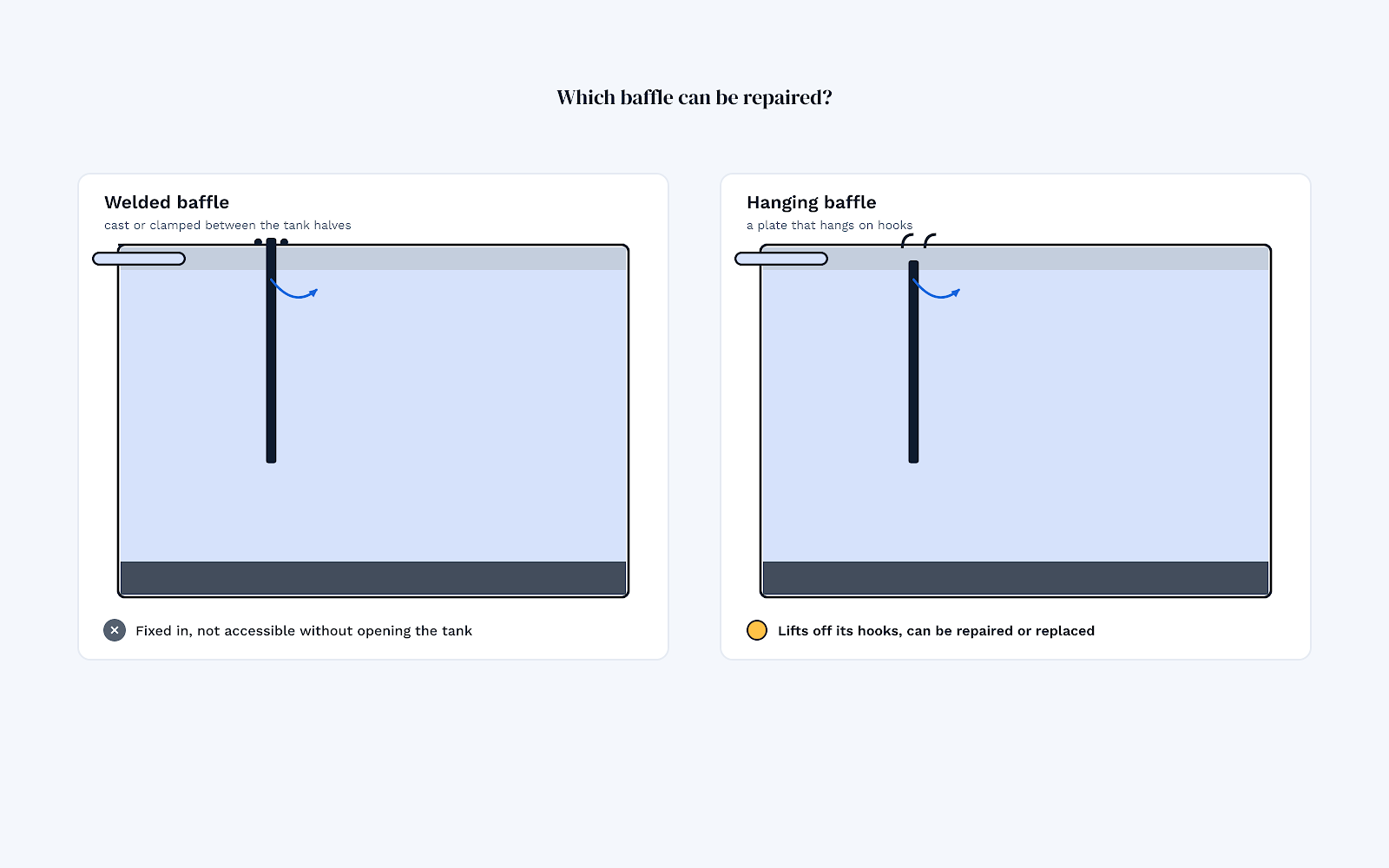
A hanging baffle lifts off its hooks, so an engineer can repair or replace it during a site visit. A welded baffle sits between the two halves of the tank, so reaching it means opening the tank up.
So, let’s get on to the reason you’re reading this: is a septic tank baffle repair possible?
This will depend on a few different factors.
Whether a septic tank baffle repair is possible depends on what type of baffle your septic tank has. The first main type is a welded ball and cone baffle, and effectively it is clamped in place around the diameter of the septic tank. The two half spheres of the septic tank wedge it firmly in place during the manufacturing process, so it’s really not likely to budge! If the baffle becomes damaged or is forced out of place, it would be impossible to repair. This is because repairing it would effectively mean digging the septic tank out of the ground and attempting to break it in to two halves again!
If you have the second type of baffle, which is a hanging baffle, it’s usually secured in place to the neck of the septic tank by a number of metal hooks. If the baffle gets knocked out of position and/or the metal hooks are damaged, a repair can be tricky. If the baffle itself is completely undamaged, and the metal hooks remain in place, then it may be possible to re-hang it. However, if the baffle or the hooks are damaged, it would mean having to fashion another method of holding the baffle in place. The problem with this? Most manufacturers don’t recommend it. Tinkering with a septic tank is not a good idea at the best of times, but messing around with the component parts might also invalidate any warranty you have left.
But there is one other reason why a septic tank baffle repair is not possible!
And this is if your septic tank discharges to a soakaway system. As I mentioned above, the purpose of a septic tank baffle is to keep the solid waste in the tank, whilst allowing the waste water to leave the tank. This then passes through the soakaway system, which is usually a network of perforated or slotted pipes which enables the waste to safely percolate through the sub soils.
What’s this got to do with a septic tank baffle repair, I hear you ask? Well, most people with a damaged septic tank baffle will find that they are also starting to have soakaway problems. This is because if the baffle is not doing its job, solid waste can leave the tank and enter into the soakaway system. Soakaways can only deal with waste water, not solid waste, and unfortunately this results in the soakaway becoming blocked. And not in a way that can be cleared through either. This kind of damage is permanent and irreversible.
So, even if a septic tank baffle repair was possible, more often than not it won’t solve the septic tank problems you’re having. Even if the septic tank started working again, the soakaway will have failed. Instead of the waste water filtering into the surrounding soil, it will be unable to do so and will just flow back to the tank, or make its way above ground. This can often cause the ground above the soakaway to become boggy, which can be one of the first things to alert you to a problem below ground.
What should you do now?
Firstly, you need a thorough septic tank inspection carried out. No problem, we can do that for you. This is really important, because you’ll want to know if it’s just a damaged baffle or a damaged soakaway that you’re dealing with. If the problem is bigger than you thought, there’s no need to stress because UKDP are on your side.
Did you know?
We can check whether you might be covered by your buildings insurance policy, and if so we can help you from start to finish. Why not complete our eligibility tracker today to find out whether your existing buildings insurance will provide cover for any works required, and if so, let the UKDP team help.
If it’s just a repair you’re after, we can do that too, and provide you with a price and recommendations to get you back up and running as quickly as possible.
Call the team at UKDP today on 0800 028 9903 or send us a message and we can talk you through how we can help.
Frequently Asked Questions
How much does it cost to repair or replace a septic tank baffle?
There's no standard price, because it depends on the baffle type and whether the soakaway has been affected too. A survey (£399 inc VAT) establishes that first; often, by the time a baffle has failed, the system needs more than a baffle fix.
Why does my septic tank keep clogging or blocking?
A damaged baffle is a common cause. Once it stops holding solids back, they pass into the soakaway and block it, so the whole system backs up. An inspection checks the baffle and the soakaway together.
Is a damaged baffle covered by insurance?
It can be, where the damage is sudden or accidental rather than age or wear. We're authorised to help with drainage insurance claims and can tell you whether there's a claim worth making after an inspection.
If the baffle has failed, does the whole tank need replacing?
Not always, but often. If the baffle has let solids reach the soakaway, the drainage field may have failed too, and that's the expensive part. A survey tells you whether a repair will hold or the system needs replacing.
How do I know if it's the baffle or the soakaway that's failed?
You often can't tell from the surface, because both cause similar signs. An inspection empties the tank, checks the baffle on camera and surveys the outlet and soakaway, so you know exactly which has failed before spending on a fix.
About the author
Sam Warren
UKDP co-founder
Sam Warren co-founded UKDP with James Warren in 2009 as an off-mains drainage specialist.
Need help with your septic tank or drainage?
Reach out to us on 0800 028 9903. Our team are here to talk Monday to Friday 9am to 5pm.
Related articles
What Is a Septic Tank Baffle?
Learn what a septic tank baffle does, why it matters and what to do if yours is damaged.
Read article
Parts of a Septic Tank Explained
Learn what each part of a septic tank does, from the chambers and baffles to the inlet and outlet, and how to spot a problem.
Read article
Is Septic Tank Damage Covered by Your Home Insurance Policy?
Understand what home insurance policies typically cover for septic tank damage, what they exclude and how to claim.
Read article